Rotisserie Management Follow on LinkedIn

Soon to be published

Your last three leaders did not fail. Your organisation cooked them.

How to Recognise, Avoid, and Escape the Corporate Slow-Roast

Rotisserie Management is a forensic and darkly funny account of how organisations hire change agents with fanfare, deny them budget, context and allies, then turn them slowly over the fire. It names the pattern, prices it and shows boards and leaders how to end it.

Follow on LinkedIn for the publication date Test your organisation

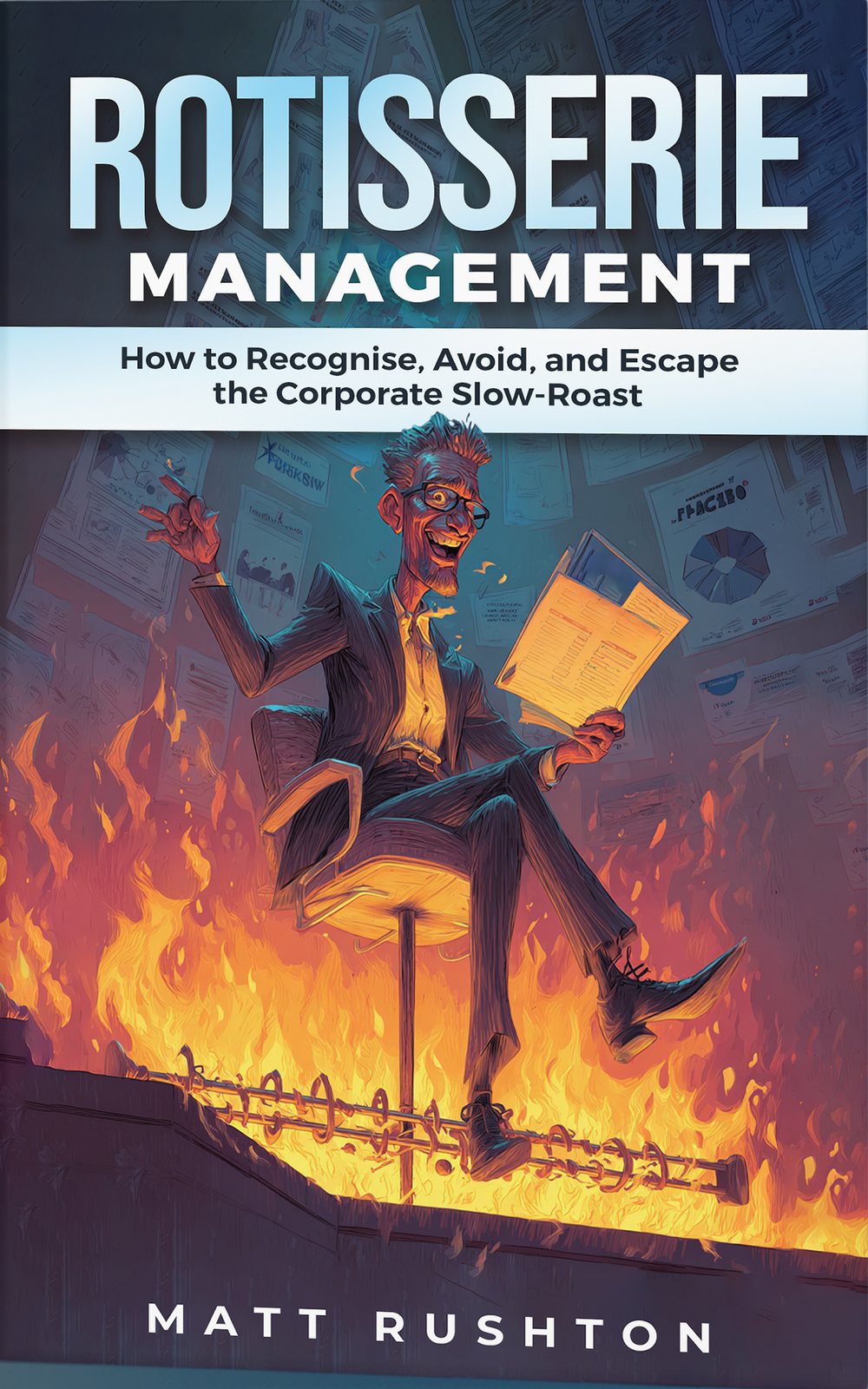
Book cover of Rotisserie Management: How to Recognise, Avoid, and Escape the Corporate Slow-Roast, by Matt Rushton. A grinning executive in a suit sits on a rotisserie spit above flames, holding a report.

Hired to represent change.
Not to deliver it.

Every senior leader knows the story. A new executive arrives with a press release and a mandate. Eighteen months later they leave “by mutual agreement”, and a recruiter is already taking calls. The board concludes that it hired the wrong person. Then it does the same thing again.

This book makes a different argument. In most organisations nobody plans the failure, and nobody needs to. Budgets are defended, context is withheld and reputations are protected, one reasonable decision at a time. The effect is the same as sabotage. The book calls it rotisserie management: slow rotation, constant heat and no single moment that anyone could be blamed for.

“The rot wants a ritual, not reform.”

Chapter One

The failure rate is not news.
The explanation is.

38% or more
Estimates of outright failure among executives in their first 18 months run from 38 per cent to more than half.
Center for Creative Leadership, Executive Integration, 2011
Under 1 in 3
Fewer than one in three transformations succeed in improving performance and sustaining the gain.
McKinsey Global Survey, 2021
48%
Strategy implementations that still failed in 2020. It was the best result in twenty years of surveys: the figure was 67 per cent in 2016 and 90 per cent in 2002.
Bridges Business Consultancy, 2020
23%
US employees who strongly agree that they can apply their organisation’s values to their work every day.
Gallup, 2016

None of these studies says the failures were intended. They say failure is normal. Rotisserie Management asks why capable people keep failing in the same seats, and what the organisation was doing while it happened.

A slow roast in six acts

The pattern runs to a script. Every act has a public version and a private one. Here is the short programme.

  1. I

    The arrival

    Day one

    On stage

    “This is the leader who will drive transformation.” A press release, LinkedIn posts and smiling photos with the CEO.

    Backstage

    “They will not last six months.” The veterans nod politely. They have seen this before.

  2. II

    The welcome

    The first weeks

    On stage

    Welcome meetings, offers of support and warmth from the board. A standard tour, an IT setup and a buddy.

    Backstage

    Nobody hands over a map of who holds power. By week two the organisation has decided what you are: a threat, or no threat.

  3. III

    The stall

    Months one to three

    On stage

    “We tried that. Timing is wrong. Let us socialise it.”

    Backstage

    Budgets sit “under review”. Meetings are rescheduled, not refused. Offline is corporate code for “let it die quietly”.

  4. IV

    The acceleration

    Months three to nine

    On stage

    You work harder. You escalate. You explain the business case again.

    Backstage

    Every push becomes a story. “Too aggressive.” “Not landing.” “Talent, but not the right fit.”

  5. V

    Dead man walking

    Months twelve to eighteen

    On stage

    A town hall, half empty. A slide titled “Roadmap to Recovery”.

    Backstage

    The board is already interviewing. In the back row, someone types “Dead man talking”.

  6. VI

    By mutual agreement

    The exit

    On stage

    A warm farewell email. “We are grateful for their contribution. We wish them well.”

    Backstage

    “Right decision.” “Not a fit.” Somewhere a recruiter is already taking calls.

New face. New promise. Same rot.

“You shake the hands that held the knife.”

Chapter One

Is your organisation running a rotisserie?

Ten of the 76 warning signs in the book’s diagnostic. Tick the ones you recognise. Nothing you tick leaves this page.

The organisation
Your team
You

Not every failed leader was cooked.

Some were the wrong hire. Some had a weak plan and blamed the organisation for rejecting it. A book that could not tell the difference would be a comfort to anyone who has ever been fired and no use to anyone else. So this one gives you the test.

Signs that point to the system

  • The pattern repeats. Two or three capable predecessors failed in the same role for similar stated reasons.
  • Promised budget, authority or headcount never arrived, and the paper trail shows it.
  • Standards are inconsistent. The newcomer is criticised for conduct that is tolerated in others.
  • Peers, team members and people who have left describe the same obstacles without being prompted.

Signs that point to the leader

  • The plan was commercially weak, and people with no stake in the old order said so.
  • The leader’s own hires performed poorly or were chosen for loyalty.
  • Complaints about the leader’s behaviour are specific, consistent and come from people with nothing to gain.
  • The leader left a similar trail in previous roles.

The useful question is not who is to blame. It is what would have had to be true for a capable person to succeed here, and whether it was.

A field guide to the machinery

The book gives the machinery names, so you can point at it in a meeting.

Rotisserie Manager
The leader on the spit. Capable, hired from outside and brought in to represent change.
The Teflon Club
The executives who survive every transition. “The inner circle changes when the boss changes. The Teflon Club does not.”
The Loyalty Cult
The organisation calls itself a meritocracy. One question settles almost every decision: how close are you to the boss?
The Performance Mirage
The dashboard that is always green. Performance is not strong. The people who designed the dashboard know exactly how to make it green.
The KPI Carousel
Rotate the metrics often enough and no trend can form. There is always a new baseline and always a new transformation year.
The Deck Industrial Complex
Where ideas are polished, socialised, reformatted and quietly buried under the weight of their own presentation.
Innovation theatre
A wall gets painted. A few beanbags appear. “The furniture changes first because furniture does not challenge anybody.”
False approval
“The minutes record a decision to proceed. The project manager walks out with applause and no money.”
The Postmortem Parade
“Then comes the postmortem. Or rather, the performance of one.” Its lessons are tidy and harmless: better communication, clearer governance, stronger alignment.
The Talent Bonfire
Good people leave in three waves. The last one takes a year or more, and nobody sends an angry email.
The Brave Exit
Leaving as an act of leadership, with a plan, a narrative and a lawyer.
“Reputation is the last thing to go in a rotisserie organisation. Right before liquidity.”

Chapter Thirteen

Three readers. Three reasons.

If you are on the spit

You were hired to change things and the ground keeps moving. The book shows you what is happening, how to tell a rotisserie from a bad quarter and when staying has stopped being leadership.

  • The early warning signs, most of them visible in the first month.
  • Eight signals that a role may be past repair, and what to check before you believe them.
  • A decision framework of five questions.
  • An exit playbook in 15 steps, starting with the lawyer.

If you sit on the board

You have replaced the leader more than once and the result has not changed. The book prices the cycle and gives you the governance to stop it.

  • A worked cost model: three failed leaders in one role, itemised.
  • Five metrics for the quarterly dashboard.
  • Five questions to answer before you brief the next search.
  • A way to end dependence on the Teflon Club without losing what its members know.

If you are watching from the middle

You have seen leaders come and go, and you have learned to keep your head down. The book explains what that costs you and the organisation.

  • Why good people leave in three waves, and why staying says nothing about ability.
  • What career protection mode does to your work.
  • A personal checklist of 32 signs, and what to do about them.

Inside the book

The subtitle is the plan of the book: how to recognise, avoid, and escape the corporate slow-roast. Fifteen chapters in four parts, and three tools you will use.

  1. Recognise

    Parts One to Three show how the rotisserie works, from the arrival to the cover-up. The Diagnostic gives you 76 signs to check against your own organisation.

  2. Avoid

    Chapter Fourteen and the Board Accountability Framework set out what a board must change: how it hires, what it measures and who it listens to.

  3. Escape

    Chapter Fifteen and the Exit Playbook cover the decision to leave and how to leave well: the signals, the counter-offer trap, the three routes out and 15 steps.

Part One: The Setup

  1. The Arrival
  2. Fuel to the Fire
  3. Culture Eats the Brave

Part Two: The Machine

  1. The Performance Mirage
  2. The Loyalty Cult
  3. The Cult of Busyness
  4. The Broken Feedback Loop
  5. The Innovation Illusion

Part Three: The Aftermath

  1. Collapse, Cover-Ups and Corporate Cartels
  2. The Talent Bonfire
  3. The Culture Assassin
  4. Toxic Infrastructure

Part Four: The Reckoning

  1. The True Cost of Rotisserie
  2. Breaking the Cycle
  3. The Brave Exit
The Rotisserie Diagnostic
76 warning signs at organisation, team and individual level.
The Board Accountability Framework
Five metrics, their triggers and a quarterly board agenda.
The Exit Playbook
15 steps in four phases, from the first honest assessment to the first week out.

“It is a boardroom grenade disguised as business literature.”

Preface

The author

Matt Rushton is an award winning leader, CEO and sales transformation strategist with more than three decades of boardroom experience. He has held leadership roles across cloud, AI, outsourcing and energy. From $100 million IT contracts to high stakes turnarounds, he has been in the trenches, led transformations and fixed what others could not.

Rotisserie Management is the book he had to write.

On the back cover

  • Why high performers quietly leave while sycophants get promoted
  • How fake transformation burns out real talent
  • The red flags of a loyalty cult workplace
  • Boardroom denial: the cost of rewarding the wrong people
  • What AI can’t fix: culture, cowardice and corporate theatre

“Wake up. Fix it. Be the leader people want to follow. Not the one they quietly hope ends up on the spit.”

The Friendly Disclaimer

Soon to be published

Follow on LinkedIn for the publication date